
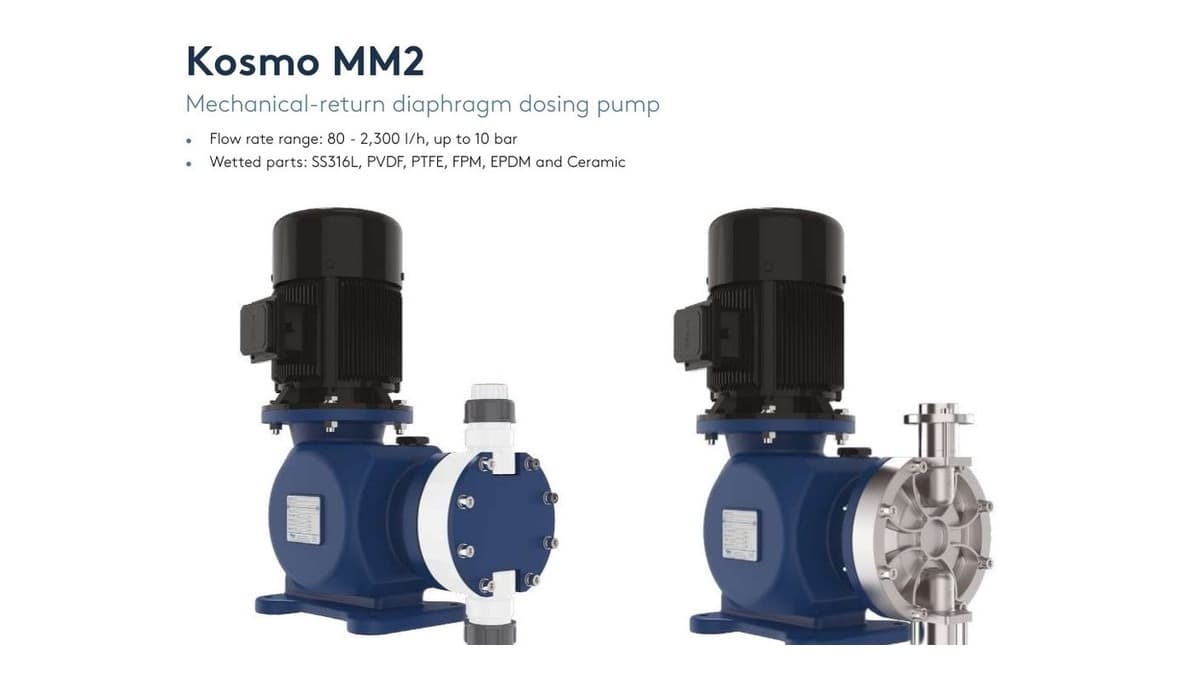
Role of Dosing Pumps in Water Treatment
Dosing pumps are used to inject controlled quantities of chemicals into water treatment and process systems. Common applications include antiscalant dosing before RO membranes, pH correction, chlorine dosing, coagulant and flocculant dosing, biocide dosing, and chemical conditioning in wastewater treatment. The purpose is not simply to move chemical from a tank to a pipe. The pump must deliver the right dose at the required pressure with acceptable accuracy and material compatibility.
A dosing pump selection should begin with the chemical, the required dosing rate, and the injection point pressure. Engineers should also confirm whether the application is continuous or intermittent, manual or automatic, proportional or fixed rate, and whether standby dosing is required. These inputs affect pump type, capacity range, stroke adjustment, control signal, accessories, and installation arrangement.
Flow Rate, Pressure, and Turndown
The required dosing flow rate is usually calculated from chemical concentration, process flow, target dose, and solution strength. Oversizing the pump can reduce control accuracy at low stroke settings, while undersizing can prevent the system from reaching the required dose. Procurement teams should ask for the normal dosing rate, maximum dosing rate, and expected adjustment range. This is especially important when process flow changes during the day.
Discharge pressure must include the pressure at the injection point, line losses, elevation differences, and any backpressure requirements. Some dosing systems need a backpressure valve to improve dosing stability. Suction conditions also matter. Chemical tank level, viscosity, flooded suction, suction lift, and priming behavior can affect pump performance. For difficult suction applications, accessories or a different pump configuration may be required.
Chemical Compatibility and Wetted Materials
Chemical compatibility is one of the most important parts of dosing pump selection. The wetted materials, diaphragm, seals, valves, tubing, and injection accessories must be suitable for the chemical being dosed. Acids, alkalis, chlorine, antiscalants, coagulants, flocculants, and specialty chemicals can have different compatibility requirements. If the chemical concentration and temperature are not known, the material selection should remain pending until the information is confirmed.
The installation should also consider chemical safety. Venting, bunding, operator access, calibration columns, flushing arrangements, and clear labeling all help reduce handling risk. In industrial sites, dosing pumps are often installed near electrical panels, tanks, and process equipment, so layout and maintenance access should be reviewed before final approval. A technically correct pump can still cause service problems if installed without access for priming, calibration, and maintenance.
Control and Automation Requirements
Dosing pumps may operate manually, through pulse input, 4-20 mA signal, timer control, pH or ORP feedback, flow proportional control, or integration with a plant control system. The control requirement should be stated clearly in the enquiry. A simple fixed-rate application may not need advanced control, while a variable flow process may require proportional dosing. Remote monitoring or alarm outputs may also be required for critical treatment applications.
For RO antiscalant dosing, interlocking the dosing pump with the RO feed pump can prevent chemical overdosing or dry operation. For pH correction, the control loop should be reviewed carefully because sensor placement, mixing time, and response delay can affect stability. For disinfection, the dosing strategy should match residual target, contact time, and regulatory or process expectations. The pump is only one part of the control system.
Accessories to consider
Foot valve, injection valve, calibration column, backpressure valve, pressure relief valve, level switch, tubing, pulsation dampener, and control cable may be required depending on the duty.
Quotation Inputs for Dosing Pumps
A good dosing pump enquiry should include chemical name and concentration, required dosing flow, process flow, discharge pressure, suction condition, control method, power supply, tank arrangement, installation location, and required accessories. If the pump is a replacement, share the existing model, pump head material, capacity, pressure rating, and photographs of the installation. This reduces uncertainty and helps the supplier prepare a more relevant offer.
ICONIC FILTRATION AND ENGINEERS LLP supplies dosing pumps and related water treatment products for industrial and commercial applications. The team can help review the application, chemical duty, operating condition, and quotation inputs before suggesting suitable product options. For final approval, model-specific datasheets and confirmed materials should be checked against the actual process requirement.
Procurement teams should also confirm what is included in the offer. A pump alone may not cover tubing, foot valve, injection valve, calibration column, panel integration, level switch, or mounting accessories. Listing these needs early prevents incomplete comparisons and helps the buyer evaluate the full dosing package rather than only the base pump price.
For critical plants, buyers should also mention required standby philosophy and site maintenance practice. A duty-standby arrangement, spare pump head, or recommended service kit may be important where chemical dosing affects membrane protection, disinfection, process stability, or compliance expectations.